
Progressive Jackpot Slots: How They Work and The Odds of Winning
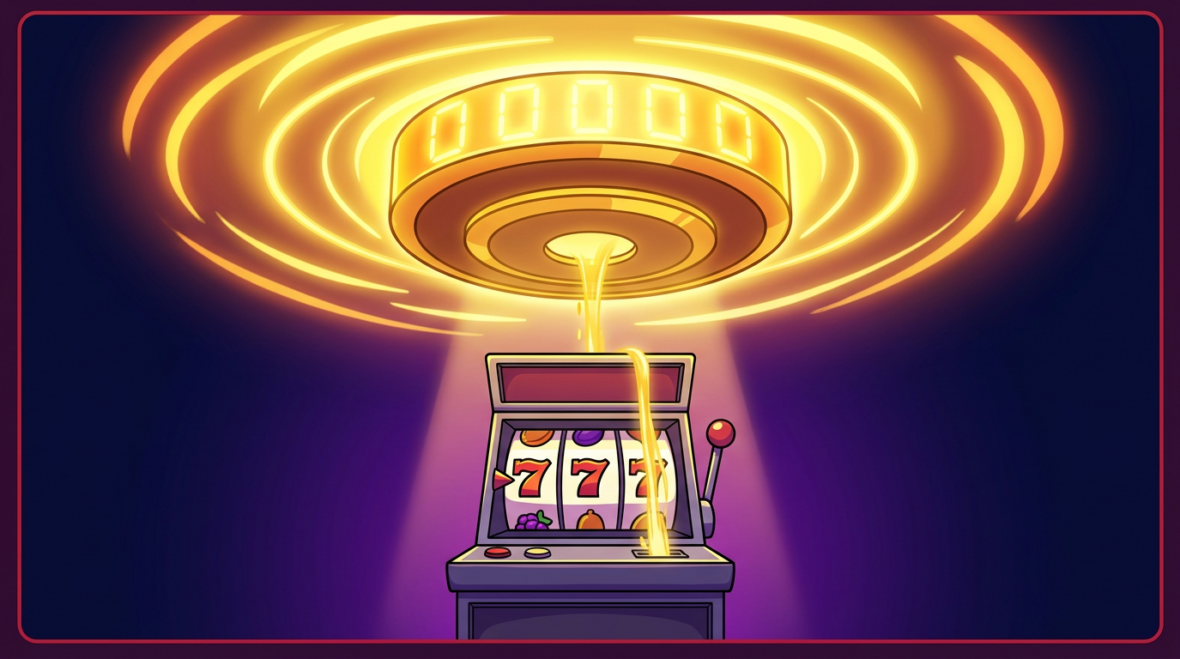
When I scroll through an online casino on a Saturday evening, my eyes almost always stop at the slots with the shimmering, constantly spinning counters. There it is: 8.5 million euros, 12.3 million euros. The amount climbs every second, each inserted coin making it rise a tiny bit further. It’s like watching a drop of water slowly but surely causing a barrel to overflow. The thought that a single click could empty that barrel just for me is electrifying. And it is precisely in that moment that it is absolutely crucial to keep a cool head, because the mechanics, the psychology, and above all the probabilities behind these “progressives” are a world of their own.
If you want to understand what progressive jackpots really are and how to make your experience with them responsible and clever, then I invite you to step with me into the engine room of these fascinating games. You will see that the dream of big money is interwoven with very precise and often merciless mathematics. That’s exactly what I want to talk about today.
What Exactly Is a Progressive Jackpot?
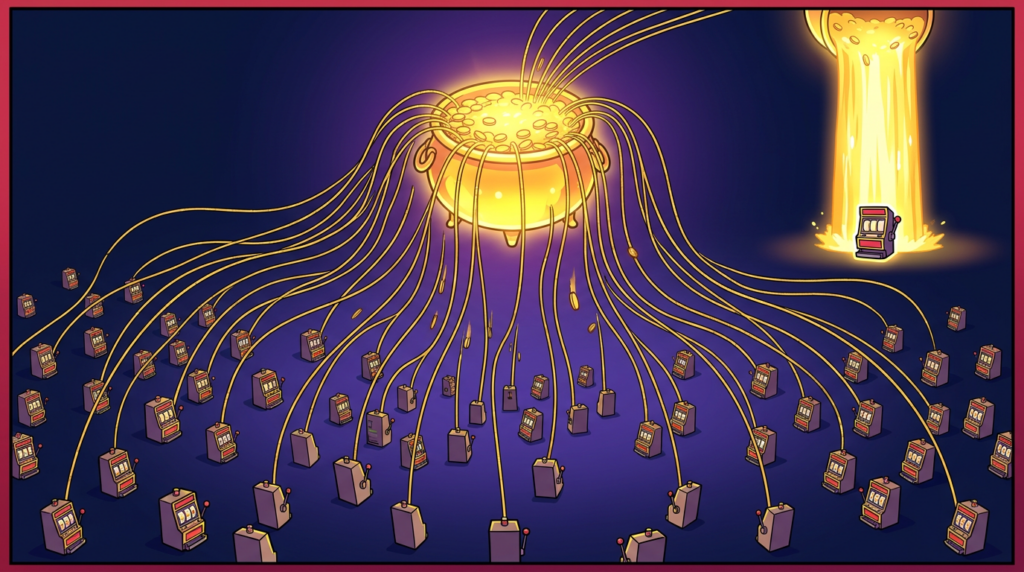
There are moments when I sit in front of the screen with a new player and they ask me whether that number up there is really a real-time counter for millions. I nod, because that is the essence of a progressive jackpot. Unlike a fixed jackpot, which offers a rigid, predefined maximum win, a progressive jackpot is a living system. It is a prize pool that grows with every single bet placed by players on a specific game – or even across an entire network of casinos.
Every time you or anyone else spins the reels, a tiny percentage of your stake is diverted into this communal pot. Imagine every player at a poker table throwing an invisible chip flake into the middle that is reserved for a special showdown. The pool swells, and it continues to swell until one lucky player hits the exact right combination or activates the special trigger mechanism. Then, in that one magical moment, the entire accumulated amount is paid out, and the jackpot resets to a base amount guaranteed by the provider, called the seed, to begin the cycle anew.
What makes progressive jackpots so irresistible is the sheer magnitude of the potential winnings. Fixed jackpots might be worth 5,000 or 10,000 euros. A progressive jackpot, on the other hand, can climb to dizzying heights of several million euros. It is this idea that a single spin could fundamentally change your entire life and that of your family that fascinates players worldwide. A British soldier once bet 25 pence and won 13.2 million pounds on Mega Moolah – a world record for online slots that still stands today. Stories like these fuel the myth and keep hope alive.
The Invisible Funding Machine: How the Jackpot Grows
When I dive deeper into the subject, I am endlessly fascinated by the funding mechanism, which is as simple as it is ingenious. It is based on pure mathematics and the law of large numbers. Put simply, every progressive jackpot is filled by the collective stakes of all players. It is not a casino that finances the jackpot out of its own pocket; rather, it is the player community itself.
From every euro you wager, a small, fixed percentage flows directly into the jackpot pool. This percentage can vary depending on the game, but it is typically between 0.5 and 5 percent. With a bet of one euro and a contribution rate of one percent, 0.01 euros would wander into the big pot. That sounds laughably small, but when you consider that at the same moment thousands of players around the world are operating the same slot machine or the same network, those cent amounts add up with breathtaking speed to the enormous six- and seven-figure sums we see on the displays.
Jackpots grow especially fast in so-called networked or wide-area progressives. Here the slot machines are linked not just within a single casino, but across several, sometimes even transnational casinos. If you play in Germany, your deposit can feed the same jackpot that someone in Canada or Scandinavia is also contributing to right now. This explains why games like Mega Moolah or Mega Fortune can reach astronomical heights so quickly.
A Cycle of Hope: Seed, Rise, and Reset

The life cycle of a progressive jackpot resembles a constant breath. It all starts with the seed, the “kernel.” This is a minimum amount guaranteed by the game developers or casinos, to which the jackpot is reset immediately after it is cracked. This seed value ensures that the jackpot is attractive again right after a payout, often a six- or high five-figure sum.
From this base value, the jackpot begins to rise again with every spin. It climbs and climbs, and the displayed counter in the game’s header races along in real time. This phase is the most psychologically intense, because with every tick of the counter, the tension seems to become more palpable. Until finally the event occurs: a player meets the trigger conditions. As soon as the win is confirmed and paid out, the jackpot falls back to the seed, and the cycle begins anew. It is an eternal cycle of collective saving and individual winning.
The Odds: A Look Behind the Glittering Curtain

Now we come to the part that humbles me anew every time I let myself be dazzled by the flashing numbers: the real chances of hitting one of these jackpots. When I talk about the topic with friends, I often find that most are not aware of the extreme, almost unimaginable odds. They are so minuscule that they explode our intuitive handling of risk and luck in everyday life.
The chances of hitting the top prize of a progressive jackpot slot are firmly programmed into the software and are typically in a range that may shock you: the probability usually ranges between 1 in 10 million and 1 in 50 million per spin. To put that into a somewhat more tangible perspective: the probability of being struck by lightning for a person in Germany over the course of a year is about 1 in several hundred thousand. The chance of the jackpot is thus comparable to being struck by lightning twice or more.
Even more important, however, is the understanding that this probability is completely independent. The random number generator (RNG) that determines the outcome of every spin has no memory. The fact that a jackpot has not been cracked for three months and has grown to an astronomical sum does not change your chance of winning it on the next spin. The chance remains exactly the same low number on every single spin, namely about 1 in 50 million. The jackpot is never “due.” This fallacy is one of the most dangerous cognitive biases that make up the appeal of these games.
The Merciless Calculus: RTP, House Edge, and Break-Even
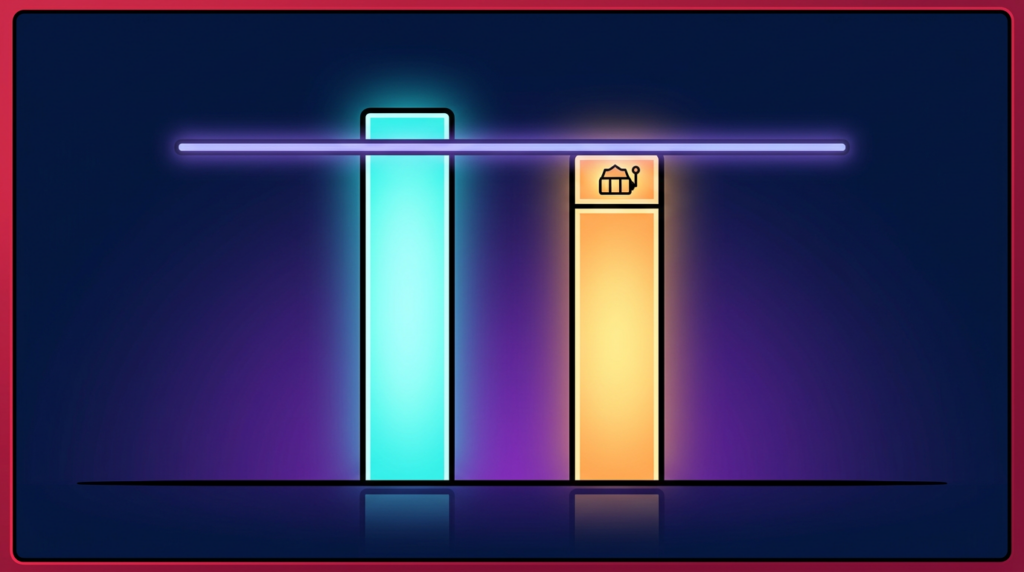
These astronomically low winning odds have a direct impact on another central metric: the payout ratio, better known as Return to Player (RTP). The RTP indicates what percentage of total stakes a slot machine returns to players in the long run, over millions of spins.
The insidious thing about progressive slots is that their base RTP is often significantly lower than that of conventional slot machines. While a normal slot might have an RTP of 96% or 97%, the base RTP of progressive slots often lies at only about 88% to 94%. The reason is simple: a portion of your bet – the contribution that feeds the jackpot – is not used for the regular wins in the base game, but is set aside for the big pot. Colloquially speaking, you are paying for participation in a lottery that runs alongside the base game with a lower constant return.
The crucial question, and the one that is most exciting for me as a player, is therefore: when does the whole thing become worthwhile? When does a pure game of chance turn into a mathematically neutral or even advantageous bet? The answer lies in the concept of break-even. The break-even point is exactly the height of the jackpot at which your statistical expected value becomes positive, at which the combination of the low base RTP and the minuscule chance of the huge win therefore turns into a mathematically fair game.
The formula for calculating the break-even jackpot, once you know the RTP and the probability of winning, is deceptively simple:
Break-Even Jackpot = (1 − Base RTP) × (1 ÷ Hit Probability) × Stake
Let’s take a concrete and well-documented example: Mega Moolah. The game has a base RTP of about 88.12%, and the chance of hitting the Mega Jackpot is about 1 in 50 million spins. Now let’s plug it into the formula:
Break-Even = (1 − 0.8812) × 50,000,000 × €1
Break-Even = 0.1188 × 50,000,000 = €5,940,000
This means that the Mega Moolah jackpot, with a one-euro bet, must have grown to almost 6 million euros before the game is statistically fair. Anything below that is a pure losing proposition with a negative expected value that makes the bookmaker or casino richer in the long run. The reality is that the historical average jackpot when cracked was about 5 million euros – often just below this mathematical turning point. The game lives in a gray area close to fairness but, on statistical average, does not exceed it.
For games with an even lower base RTP and a similar hit probability, such as Wheel of Fortune, which can have an RTP of only 87%, the break-even at the same stake is already at 6.5 million euros. It is a merciless calculation: most of the time, you are playing with a significant mathematical disadvantage.
A Typology of Dreams: The Different Types of Jackpots
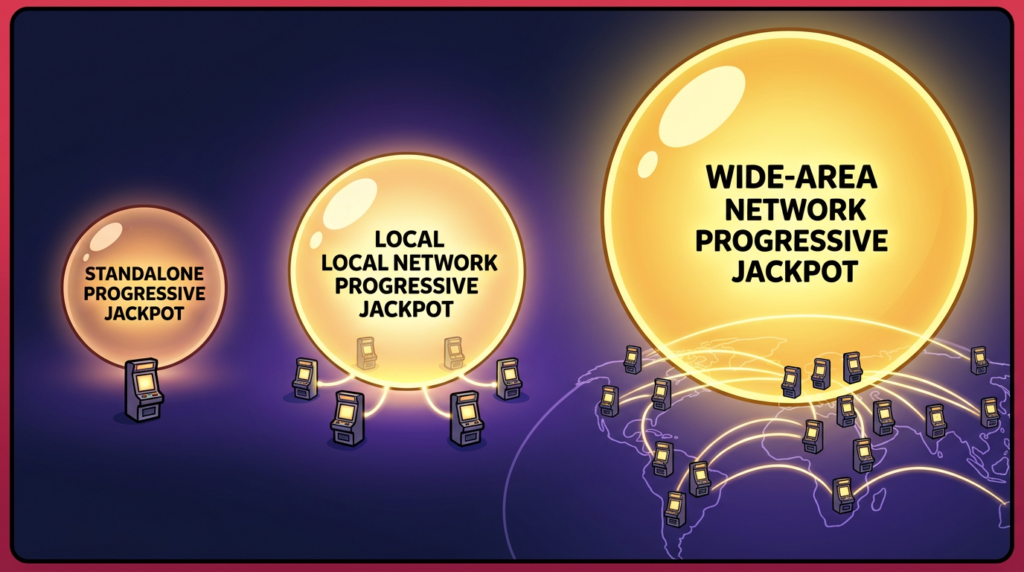
Not all progressive jackpots are created equal. When I try out a new slot, it helps me to differentiate between three main types to better assess the risk and the winning probability:
- Standalone Progressive: This is the “smallest” and most local version. The jackpot grows only through the stakes on that one, specific slot machine in a casino. The wins here are significantly lower, often in the range of a few thousand to ten thousand euros. In return, the odds of cracking it are, statistically, also the highest.
- Local (In-House) Progressive: Here, several slot machines within a single casino (or an online platform) are linked together. The pool is filled by the players of that casino together, which causes the jackpots to grow faster and higher than with a standalone device.
- Networked (Wide-Area Network) Progressive: These are the kings, the globe-spanning million factories. Games like Mega Moolah, Mega Fortune, or Hall of Gods link players across hundreds of casinos and several continents. This is where the famous, life-changing multi-million-euro jackpots arise. However, the winning probability is also by far the lowest here, as the number of participating players is gigantic.
More Than Just the Mega Jackpot: Tiered Win Levels

Many modern progressive slots no longer follow the simple “all or nothing” principle. They offer tiered jackpot levels, which are often fittingly called Mini, Minor, Major, and Mega (or Grand). These multi-level systems are a psychologically brilliant move, because they create more frequent feelings of success, even if the really big dream remains out of reach.
While the Mega jackpot offers the chance at the multi-million-euro main prize, the levels below it like Major or Minor can be cracked with significantly higher probability and still often pay out considerable sums in the four- or five-figure range. In my reviews on this website, I always pay attention to how transparently a provider communicates the hit probabilities and the current values of these different levels. It is a sign of fairness if you can see exactly what each individual jackpot level is worth and how it is triggered.
The Psychology of an Illusion: Why We Still Play
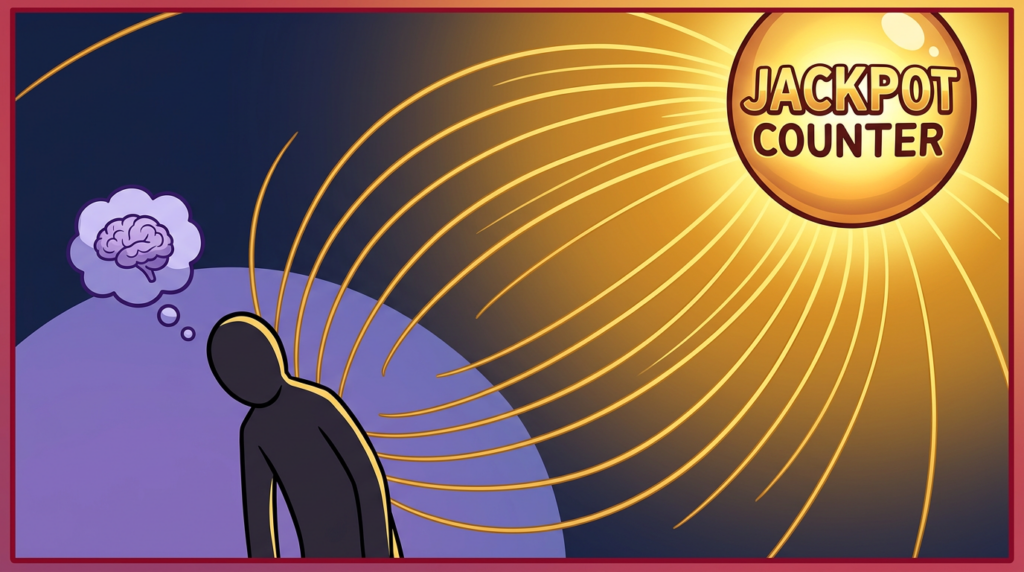
After knowing all this – the low RTP, the astronomical odds – I sometimes sit there myself and ask why my gaze still keeps lingering on those ticking counters. The answer lies in the brilliant but also perfidious psychology of these games.
The constantly rising jackpot counter is a masterpiece of marketing psychology. It creates an artificial urgency, a loss aversion that suggests to us: “If I don’t play now and someone else cracks the jackpot, then I will have lost my share of this collective pot forever.” This fear of missing out is a powerful motivator. At the same time, the sight of the steadily growing sum leads to the gambler’s fallacy, that feeling that the win is now overdue, that the jackpot “must” surely fall soon. As I have already explained, that is mathematically complete nonsense, but emotionally it is immediately understandable and incredibly effective.
The Safe Space: Responsible Handling of the Million-Dollar Dream

As someone who tests and reviews countless casinos, the most important part of this whole complex for me is player protection. The German State Treaty on Gambling 2021 (Glücksspielstaatsvertrag 2021, GlüStV 2021) has created a strict framework for player protection in Germany, which is indispensable, especially for high-risk game forms like progressive slots. The Joint Gambling Authority of the Federal States (GGL) monitors compliance with these rules and provides the official whitelist of all legal providers.
What does that mean concretely for your play on progressive slots?
- The cross-provider deposit limit of €1,000: It is your most important protective wall and is technically enforced via the LUGAS system. You can and should set your personal limit significantly lower, ideally before the first spin, while your head is still completely clear.
- The OASIS player self-exclusion system: If you should ever feel that the chase for the big win or the losses are taking control, you can exclude yourself nationwide from legal gambling with just a few clicks. This is not a weakness, but an act of self-care that I recommend to anyone who has even the slightest doubt about their own gambling behavior.
- Support services: If gambling behavior should become burdensome, you can reach the BIÖG helpline for gambling addiction free of charge and anonymously at 0800 1 37 27 00 (in Germany). The portal www.check-dein-spiel.de also offers an anonymous self-test with which you can honestly assess your own risk profile.
Playing Smart: Strategies for a Cool Head
So, can you add a positive strategy to playing progressive slots? My clear answer is: yes, but not in the sense of a guarantee to win. The strategy is one of inner attitude and clear budget control. Here are the principles that I have internalized for myself and that I warmly recommend to you:
- Always bet the maximum amount, but only with a clear limit. The most important rule upfront: on almost all progressive slots, the full stake per spin is required to qualify for the main jackpot. A lower stake would leave you empty-handed in the event of a win. So if you are playing with the intention of winning the jackpot, you have to bet the maximum amount per line or spin. But, and this is the decisive point, do this only if that bet amount fits within your previously set budget and your personal limit. Never play the maximum amount if it puts you under financial pressure.
- Choose games with a fair base RTP. Even if the allure of the jackpot is the main focus, you should pay attention to the base payout ratio. A progressive slot with a 94% RTP will give you back more of your money in the base game in the long run than one with only 88%. The difference may seem small, but over a thousand spins it makes an enormous difference for your staying power and your gaming enjoyment.
- Never view progressive jackpots as an investment strategy, but as what they are: expensive entertainment with an extremely small chance of a fantastic win. Everything else is a dangerous self-deception. I determine before each session how much money I am willing to pay as an entry fee for this thrill, and as soon as that budget is used up, the game is over – period. No excuses, no “just one more spin.”
- The only strategy that does not improve the odds but guarantees your safety is the use of the mandatory protection features. Use the reality checks that regularly remind you of your playing time and your losses. Use your personal deposit and loss limits. These tools are your co-pilots, ensuring that the dream does not become a nightmare.
Conclusion: The Dance with Mathematics

Progressive jackpots are the perfect embodiment of the great casino dilemma: they link one of the most beautiful human dreams – that of a lightning-fast, fateful turnaround – with one of the most merciless mathematical realities. The chances of hitting the big jackpot are as thin as the gold foil on a praline. They are the icing on the cake of a game that already has a significant house edge on its own.
Personally, I enjoy the sight of those ticking sums, I follow with curiosity when a big pot is finally cracked, and I wholeheartedly grant every winner their unbelievable luck. But I never bet a cent without first visualizing the numbers behind the glitter: the base RTP, the estimated win probability, and the resulting, almost always negative, expected value. I am aware that I am paying for the dream, not for the win.
On this website, you will find reviews of countless slot machines and the casinos where they are offered. We scrutinize the numbers, the RTP values, and the player protection mechanisms for you, so that you can make your decisions based on facts and not just on sparkling promises. My request to you: the next time you stand before a progressive jackpot ticking at 16 million euros, enjoy the sight, feel the thrill, but play with a clear head, a firm limit, and the deep knowledge that mathematics is a patient, incorruptible opponent. And should you ever feel that the dance with the dream is getting out of control, you now know where the emergency exits are. Use them.